Most "summer fabric" advice is written for dry heat, and it quietly fails the moment the humidity climbs. That's because dry heat and humid heat are different problems. In dry heat, sweat evaporates off your skin instantly, so almost any breathable fabric works. In humidity, evaporation stalls — the air is already saturated — so the fabric touching you has to actively move and release moisture, not just soak it up. That single change reshuffles the whole ranking, and it's why cotton, the default hot-weather fabric, is actually a trap in the tropics.
The short answer: the best fabric for hot, humid weather is linen, followed by Tencel/lyocell, tropical-weight merino and seersucker. Avoid plain heavy cotton (it saturates and clings) and polyester or synthetics (they trap heat and odor).
The best fabrics for humid heat, ranked
Linen
The benchmarkNothing beats it in humidity. Flax fibres conduct heat away from the body, and linen's open weave and hollow fibre structure let it hang off the skin and release moisture through evaporation faster than any other natural fibre — it beats cotton on moisture-vapour transport, and dries far quicker. The trade-off is that it wrinkles, but that reads as intentional relaxed-luxury, and a lightly rumpled linen shirt is doing more to keep you dry than a pressed one. Best for shirts, trousers and unlined jackets.
Tencel / Lyocell
The technical naturalMade from wood pulp, Tencel wicks moisture roughly three times faster than cotton and dries quickly — and crucially it stays opaque when damp and has a smoother, dressier drape than linen. That makes it the best pick when you want to look a little sharper than linen allows (a soft shirt or trouser) without giving up performance. Often blended with linen or cotton to get the best of both.
Tropical-weight merino
The anti-odor pickThe sleeper option — but weight is everything. Lightweight merino (around 150 gsm or lighter) absorbs up to about a third of its weight in moisture before it feels damp, then releases it gradually, and it's naturally antibacterial, so it resists odor over several wears. That makes a fine-gauge merino polo or tee the ideal travel piece for humid heat. The catch: standard-weight merino is too hot — get the weight wrong and it fails.
Seersucker
Construction beats fibreHere the weave does the work. Seersucker's puckered texture holds the cloth off your skin, creating little air pockets that keep it from clinging when you sweat — a construction-level solution to the exact problem humidity creates. The texture also camouflages any sweat mark. Reworked in muted, tonal colours (not the old preppy blue stripe) it's one of the smartest hot-weather shirt and jacket fabrics going.
Cotton — but only light weaves
Fine in a pinchCotton's reputation as a hot-weather fabric only half holds up. Thin, open cotton weaves — poplin, chambray, voile, madras — are cool and fine for shirting, especially in pale colours or a pattern that hides a sweat mark. But cotton absorbs moisture into the fibre and can't move it along the surface, so anything heavier saturates and stays wet. Use light cottons freely; keep heavy ones out (see below).
Bamboo / viscose
The budget breathableBamboo-derived viscose is soft, breathable and naturally antimicrobial for odor control, which makes it a decent value pick for tees and polos. It's not quite at the level of linen or Tencel for drying speed, but it's a big step up from ordinary cotton and streets ahead of any synthetic.
Plain, heavy cotton
AvoidThe big trap, precisely because it feels natural and "breathable" when dry. In extreme humidity, a heavy cotton tee or denim soaks up sweat, goes heavy and clammy, dries slowly and can start to smell. It's the single most common hot-weather mistake — reach for linen, Tencel or light cotton instead.
Polyester & synthetics
AvoidThe worst choice for all-day humid heat. Polyester is hydrophobic, so instead of absorbing sweat it lets it pool in the gaps between the fibres, against your skin — the clammiest feeling there is — and those same gaps trap the oily molecules that skin bacteria turn into odor, so the smell builds through the day. (Engineered performance synthetics wick and dry fast enough for a gym session, but they're wrong for a long day worn against the skin.)
The fabric ranking at a glance
| Fabric | Humidity verdict | Best for |
|---|---|---|
| Linen | Best — releases moisture fastest | Shirts, trousers, unlined jackets |
| Tencel / lyocell | Excellent — wicks 3× cotton, opaque when damp | Soft shirts, trousers, tees |
| Tropical merino (≤150 gsm) | Excellent — anti-odor, multi-wear | Polos, tees, travel |
| Seersucker | Excellent — weave lifts off the skin | Shirts, warm-weather jackets |
| Light cotton (poplin, chambray) | OK — keep it thin and pale | Shirts |
| Bamboo / viscose | OK — breathable, budget | Tees, polos |
| High-twist tropical wool | Best for tailoring — crisp in humidity | Blazers, dress trousers |
| Heavy cotton | Avoid — saturates and clings | — |
| Polyester / synthetics | Avoid — traps heat and odor | — |
What about tailoring? High-twist tropical wool
If you need a jacket or dress trousers in the heat — for work, dinner or a wedding — the answer is counterintuitive: not linen, but high-twist tropical wool (also sold as "fresco"). Its open, porous weave passes air straight to the skin, it's surprisingly wrinkle-resistant, and it holds a crease where linen slumps. Pair it with unstructured, unlined construction — a full lining is a second heat-trapping layer across your back — and you get tailoring that survives 34°C. It's the one wool that belongs in a tropical wardrobe.
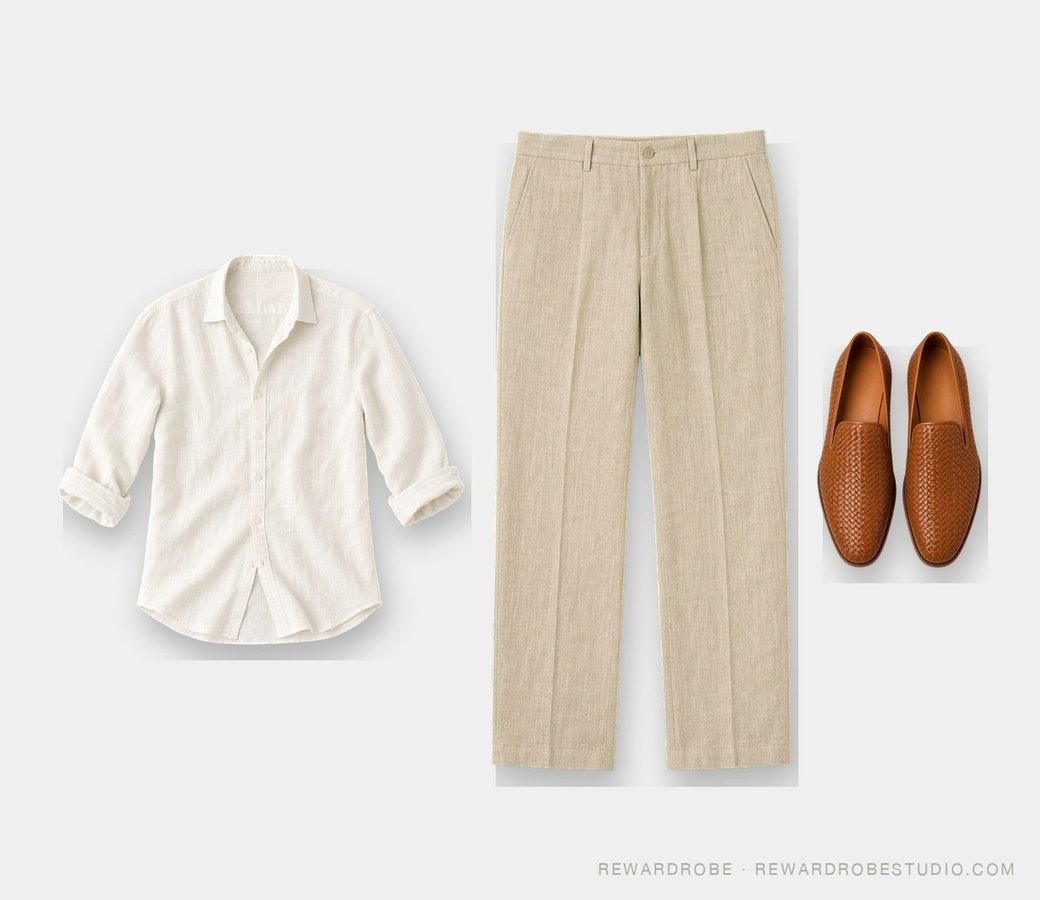
One more thing: colour hides sweat too
Fabric keeps you cool; colour keeps you looking cool. Sweat shows least at the extremes of brightness — pure white (no dye to darken when wet) and true darks like navy — and worst in the middle, where light grey is the number-one offender and mid-blue is close behind. Patterns and textures (seersucker, chambray, a micro-stripe) break up a mark too. So the sweat-smart move is to pair the right fabric with a pale palette and keep any dark tones to a jacket, where they hide sweat rather than show it.
The Tropical Edit — 45 hot-weather looks from 21 pieces
The Tropical Edit takes every fabric rule here and builds it into a real capsule: 21 breathable pieces that make 45 photographed looks for extreme heat and humidity, with a full fabric-and-sweat guide and a shopping checklist by fabric criteria — so you buy the right thing, anywhere.
Best fabrics for hot, humid weather: quick answers
Is cotton or linen better for humidity?
Linen, clearly. Cotton absorbs moisture into the fibre and holds it, so a cotton shirt saturates and clings in humidity; linen's open weave releases moisture and stays off the skin. Light cottons like poplin and chambray are acceptable; heavy cotton is the one to avoid.
What is the coolest fabric to wear in extreme heat?
Linen for breathability, or Tencel/lyocell for wicking. Linen conducts heat away and dries fastest; Tencel wicks about three times faster than cotton and stays opaque when damp. Seersucker is also excellent because its puckered weave holds the cloth off your skin.
Does merino wool work in hot weather?
Yes, but only in tropical weight (around 150 gsm or lighter). Lightweight merino absorbs a lot of moisture before feeling damp and is naturally anti-odor, which is ideal for multi-day travel in heat. Standard-weight merino is too warm.